
How to apply for IECEE certification, EER certification, certificate template, price and cost, and timing for exporting lighting fixtures to Saudi Arabia
Lamps are an important product type exported from China to Saudi Arabia, with large amounts and many types; since Saudi Arabia announced that all lamps and lanterns products under the regulations of SASO2870:2018 and SASO2902:2018 will need to obtain SASO certificates and IECEE certificates before April 1, 2019, so that these imported products can be successfully cleared at Saudi Customs. The friends who make lamps are all blown away! Suddenly various costs, including certificate fees, are so expensive? Are you still allowed to ship? What is the difference from raising tax rates in the United States? The following is a brief introduction to Saudi Arabia’s testing and certification requirements for lamps.
Certification process for lamps exported to Saudi Arabia-Saudi EER certification for LED lamps
1. IEC report + CB certificate of lamps
2. Energy efficiency test + energy efficiency registration (EER) of lamps
3. SASO IECEE registration of lamps
4. SABER registration of lamps
5. SABER PC certificate application
6. SABER SC certificate application
Saudi Arabia energy efficiency EER-LED lamps Saudi EER certification
Let’s first talk about energy efficiency. As far as lamps are concerned, there are currently two standards for energy efficiency, namely: SASO2870:2018 and SASO2902:2018, SASO2927:2019. These three standards are all energy efficiency standards, but the scope of controlled products is different.
SASO2870:2018 Standard Introduction-LED Lamps Saudi EER Certification
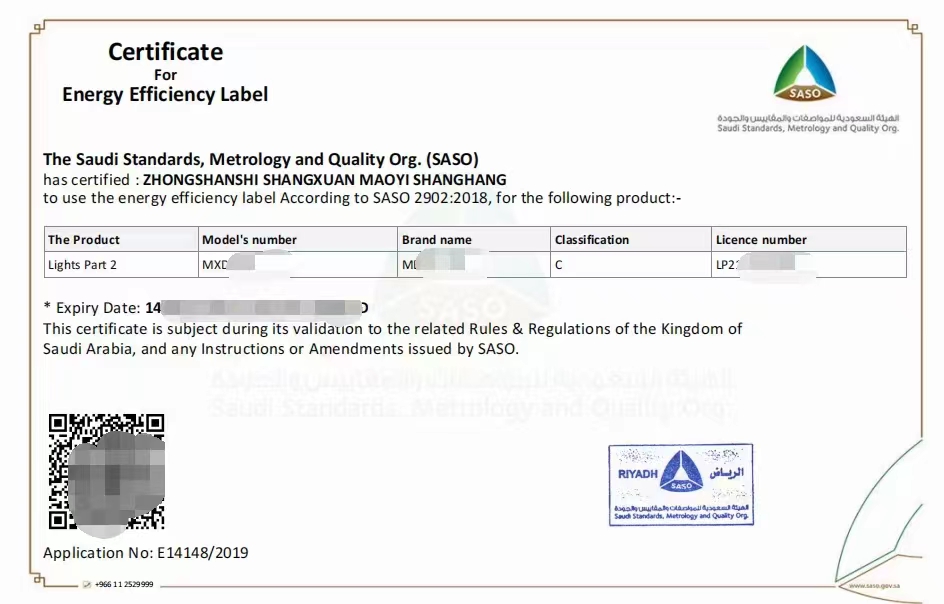
Various directional and non-directional light sources for general lighting with a luminous flux of 60-12,000 lumens, including:
Tungsten bulbs, self-ballasted energy-saving lamps (CFLi), halogen bulbs, LED bulbs that replace tungsten lamps, LED lamps that replace halogen lamps, LED lamps whose light sources cannot be replaced
All light source products that fall into the following customs codes fall within the mandatory scope of SASO 2870:
853910000001-853910000002-853910009999-853921000001-853921000002
853921000003-853921000004-853922000001-853922000002-853929000001
853929000002-853929000003-853929000004-853931000001-853931000002
853931009999-854370900009-854370900010-854370909999
SASO2902:2018 just supplements SASO2870:2018:
SASO 2870:2018 Certificate Template-LED Lamps Saudi EER Certification
Introduction to SASO2902:2018 standard-Saudi EER certification for LED lamps
Tungsten lamps, halogen lamps, and self-ballasted fluorescent lamps with a luminous flux greater than or equal to 12,000 lumens
Compact model fluorescent lamp without ballast
All types of fluorescent lamps
High intensity discharge lamp (mercury lamp, high/low pressure sodium lamp, quartz/ceramic metal halide lamp)
LED lights (including LED lights greater than or equal to 12,000 lumens)
Non-replaceable light source fixtures:
Directional integrated lamp
Non-directional integrated light fixture
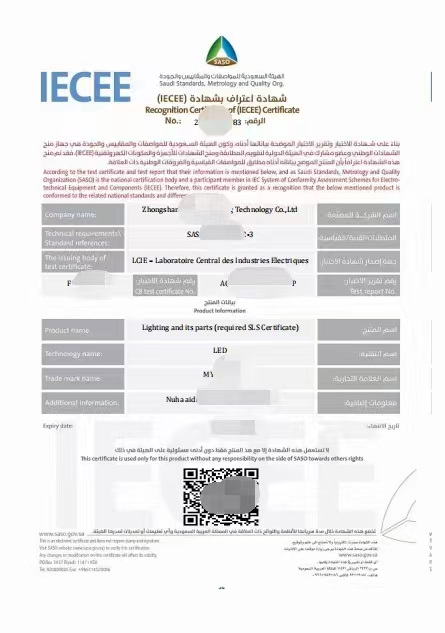
Saudi IECEE certificate template-LED lamps Saudi EER certification
SASO 2902: 2018 Certificate Template-LED Lamps Saudi EER Certification
Products exempted from EER energy efficiency-LED lamps Saudi EER certification
1. Lamps for special end users
For example: traffic lights, heating lights, solar street lights
2. The main purpose is not lighting function
For example: LED display, emergency light (escape indicator light), photo display light, battery-powered light (torch)
3. Products exempted due to technical reasons
Light source with diameter 7mm (T2) and below; diameter 16mm (T5) but power ≤13W or >80W, etc.
The specific exemption list is not listed here.
EER exemption product certificate template-LED lamps Saudi EER certification
EER exemption certificate template
It is worth mentioning that in addition to energy efficiency requirements, all lamps have hazardous substance testing requirements, which is the RoHS report we often do.
EER energy efficiency test and EER energy efficiency registration-Saudi EER certification of LED lamps
There are currently two types of energy efficiency tests on the market. The main difference lies in whether the 6000-hour life test is complete.
If 6000 hours of complete testing is completed, the timing will definitely be relatively long. Even if the testing is done day and night, it will take 250 days.
This kind of timing is unacceptable to most exporters unless arranged one year in advance. In addition, the cost is relatively expensive.
Of course, the Saudi official has considered this situation. As long as the exporter can provide a test statement issued by a third-party agency recognized by Saudi Arabia and indicate the test completion time, and the exporter guarantees in writing to provide the official with the test report within 15 days of the test completion time, the official is allowed to issue an EER registration certificate first.
Another kind of test report is that the 6000-hour life test is not completely tested, but is only calculated based on the existing test data. The test cost is relatively cheap, and the report can be issued in about 15 working days. Of course, strictly speaking, this kind of test report is not accepted by Saudi Arabia, but because the current Saudi policy is not very complete, you can also apply for EER registration.
Exporters need to choose which type of test report to make based on their actual needs.
In addition, we will not introduce the specific test content of energy efficiency here. They are all technical content and relatively boring. If you want to know more, you can find us for further information and contact us.
EER certificate report validity period-LED lamps Saudi EER certification
The validity period of the EER certificate is 1 year
Licensee: Manufacturer
The energy efficiency test report used to apply for EER registration must be within 2 years, otherwise it will be invalid.
After the test report is issued, you still need to provide the following documents to apply for EER registration:
The registration timing of EER is approximately: 8~12 working days.
After energy efficiency is completed, the next step is IECEE registration. Before registration, you must first pass CB certification.
Saudi Arabian lamps CB certification-LED lamps Saudi EER|CB certification
CB certification is the same as the safety certification we usually do, except that the test standard uses the IEC (International Electrotechnical Commission) standard.
In general:
LED bulbs use IEC62560 standards; lamps use: IEC60598 standards
Similar to all lighting safety tests, the main requirements are eight categories:
1. Classification: Class I, Class II, Class III
2. Identification: Basis for testing
3. Mechanical protection: reliable connection; sharp edge protection
4. Electrical protection: grounding protection; insulation protection; creepage distance
5. Waterproof and dustproof: IP test
6. Thermal Protection: Temperature Test
7. Fire Protection: Material Testing
8. Other protection: UV, laser, explosion, etc.
In addition, there is a unique test for LED bulbs: photobiological safety test (including UV test and blue light hazard test)
Regarding the test content, we will only briefly introduce the points that need attention in classification and labeling. If you are interested in the specific test content, you can directly look up the standard content of IEC62560 and IEC60598.
Category:
1. Can be classified according to the level of electric shock protection
Class I: Ground protection (with ground wire)
Class II: No grounding protection, double insulation
Class III: Low Voltage
2. According to the waterproof and dustproof level (IP)
The first digit represents the dustproof level, from 1 to 6: (50mm, 12mm, 2.5mm, 1.0mm, 0mm)
The second digit represents the waterproof level, from 1 to 8: (drip, shower, splash, spray, immersion)
General indoor use: IP20
Outdoor use: IP44, IP65, etc.
3. Mounting surface for use as designed
4. According to usage environment
Identification:
Basic contents that must be marked on lighting products:
1. Production factory or responsible agent or trademark
2. Model and rated parameters
3. Protection against electric shock level
4. IP level
5. Illumination distance (required for floodlights and street lights)
6. Others, such as special light bulbs, harsh environment use, better protection, etc.
Another thing to note: a nameplate is required
The height of the text on the nameplate is not less than 2mm, and the height of the symbols is not less than 5mm;
The nameplate material must be wear-resistant and waterproof (printouts and material samples can be provided)
It is also worth mentioning that the temperature test requirements include a durability test that requires continuous power supply for 7 to 10 days.
There are some IEC reports on the market that issue reports within 5 to 7 working days, which are definitely not actual tests or at least incomplete tests. Please don't be fooled.
In addition to the overall IEC test, the accessories of the lamp, that is, the key components, also need to be certified. If there is no certification, additional random testing fees will be incurred. This must be noted!
For example:
IEC/EN 61558: Transformer
IEC/EN 60238, 61184, 60838: Lamp holder
IEC/EN 60083: Plug
IEC 60227, 60245: Connecting cable
For your benefit, please look for the IEC report and CB certificate issued by a laboratory with CBTL qualifications
With the CB report and CB certificate, you need to apply for IECEE registration.
LED lamps Saudi IECEE registration--LED lamps Saudi EER certification
☆☆☆What is IECEE?
Do we have any impression when IECEE is mentioned? Have we seen such a logo on CB reports and CB certificates?
So now that we have a CB certificate, why do we still need to register for IECEE?
Let’s first study the definition of IECEE:
1. Refers to the IEC conformity assessment system for electrical equipment and components. It is a multinational certification system based on IEC international standards, and its members use the principle of mutual recognition of test results to obtain certification or approval from countries around the world. The IECEE system involves the safety, efficiency and overall performance of components, instruments and equipment in homes, offices, workshops, health care facilities, etc. IECEE covers a total of 23 categories of electrical and electronic equipment and testing services.
2. Refers to a new certification implemented by SASO in early 2018 to ensure that the standard system, quality guidelines, consistency assessment, etc. issued by Saudi Arabia comply with international standards and WTO requirements. The nine major categories of goods covered by the certification must have a mandatory IECEE certificate before they can be cleared at Saudi Customs before entering the Saudi market. Certification is implemented in phases.
Are these two the same certification? Obviously, Saudi Arabia's IECEE certification (registration) is not the same thing as the International Electrotechnical Commission's IECEE. This is just a policy of the Saudi government and has nothing to do with the International Electrotechnical Commission!
Saudi IECEE certificate template-LED lamps Saudi EER certification
Control scope of Saudi IECEE certification-Saudi EER certification of LED lamps
Phase 1: February 2018
Mobile phones; mobile phone chargers and accessories; batteries (mobile phones, vehicles)
Phase 2: August 2018
Water pumps; electric motors; dishwashers; portable computers; television equipment
Phase 3: 2019
Lighting equipment
Documents required to apply for Saudi IECEE:
1. CB test report and certificate valid for three years
2. Valid test report including country differences (if any)
3. The importer’s business license in Saudi Arabia including the date of establishment and legal representative
4. Manufacturer’s business license (it is recommended not to use the trader’s)
5. English and Arabic instructions, etc.
The application period for the IECEE certificate is 15 to 20 working days, and the validity period of the IECEE certificate is 1 year.
Next we will focus on explaining the SABER system
LED lamps exported to Saudi Arabia SABER registration--LED lamps Saudi EER certification
Speaking of SABER, let’s first mention Saudi Arabia’s SALEEM plan.
The Kingdom of Saudi Arabia started piloting the “Saudi Product Safety Plan”, or SALEEM, on January 1, 2018. This plan can be understood as an upgraded version of the current SASO CoC.
Under the new SALEEM project requirements, the products in the control list must comply with the technical regulatory requirements specified by SASO, and will include the following two stages of product conformity assessment:
Stage 1: Evaluate the corresponding product according to the product evaluation plan specified by SASO. If it meets the requirements, issue a Product Certificate. This is what we call the PC certificate.
Stage 2: After obtaining the PC certificate, the goods under the product certificate of each batch of shipments will be evaluated, and a batch certificate Shipment Certificate, which we call the SC certificate, will replace the current CoC certificate for customs clearance of the goods at the destination port.
Saudi Saber PC PCOC Customs Clearance Compliance Certification Certificate Template
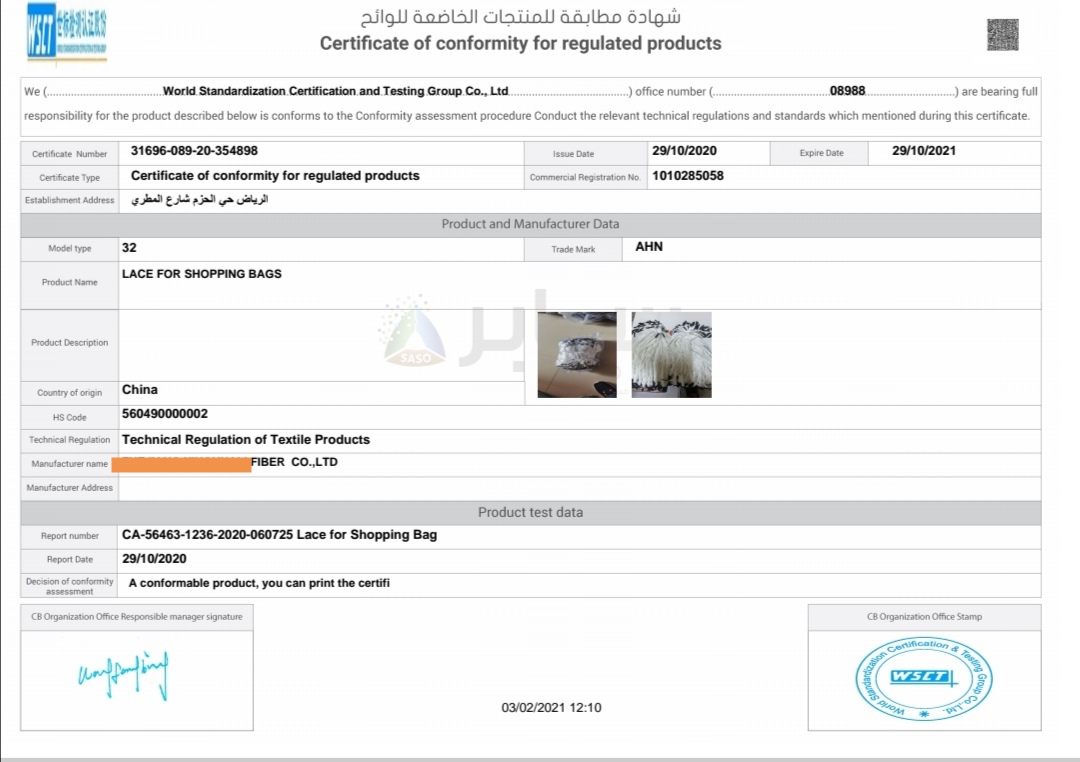
Saudi Saber PC PSOC Customs Clearance Compliance Certification Certificate Template
SALEEM project control list:
1. Building products
2. Chemical products
3. Mechanical
4. Toys
5. Textiles
6. Low voltage equipment
7. Products required for energy efficiency certification (such as lighting fixtures)
8. Others
The above list is a list of products controlled by the SASO plan. Not all of them have been implemented at present. Not all products can currently be registered through the SABER system. The specific product list implemented on the SABER system is implemented step by step. Let us first introduce the SABER system.
SABER system
The SABER platform allows investors and local manufacturers to obtain prescribed electronic certificates of conformity and batch certificates of conformity for consumer goods entering the Saudi market, whether imported or locally manufactured. The platform is designed to protect businesses from fraud and ensure products are free of defects that could affect consumer health and safety.
Through the SABER system, importers and local manufacturers can easily apply for conformity certification certificates (product and batch goods conformity certification certificates) for products.
* For products not regulated by Saudi Arabia’s technical regulations, only a self-declaration via a SASO-approved form is required and no type approval certificate is required.
Validity period: one year
Required supporting documentation:
Compliance certification documents, such as test reports, quality certificates, risk assessment reports, inspection reports, etc. (if applicable);
Product design, dimensions, drawings, specification photos (if applicable).
————END————
☆☆☆ Batch Goods Conformity Certification Certificate (SC Certificate)
Validity period: Batch valid
Required supporting documentation:
Type Approval Certificate/Self-Declaration
Shipping documents such as invoices, packing lists, bills of lading, etc.
Each shipment requires a Batch Conformity Certificate. For products that have passed technical regulation supervision and are included in the SABER system or unregulated products, batch cargo conformity certification certificates are issued through SABER.
☆☆☆ SABER implementation
Currently, SABER is in the process of gradual implementation according to each technical regulation. After implementation, products subject to relevant technical regulations will need to prove through the SABER platform that they comply with the relevant provisions of technical regulations. These products are then issued certificates of conformity through the SABER system. (Since the list of controlled products is implemented gradually, please pay close attention to the latest list)
Until SABER is registered and the SC certificate is issued, the certification of a lighting product is truly over.
Note: The SABER system requires Saudi buyers or local merchants to register online. We cannot register in China. If you want to register, you can only entrust us (certification agency).
Let’s take a look now. How much does it cost for a lighting manufacturer to export one product (one product name) and one model (if there are multiple models, the cost will be more) to Saudi Arabia?
1. Energy efficiency test report cost, approximately: 2000-4000 RMB/copy
2. SASO 2902 Energy Efficiency Registration Certificate EER fee: Different energy efficiency levels have different fees, 3000-5000 RMB/copy
3. TUV&CB report + TUV&CB certificate fee: 15000-26000 RMB/copy
4. IECEE registration certification fee: 9000-12000 RMB/copy
5. PC certificate + SC certificate fee: 2000-5000 RMB/piece
The above fees are only estimates. The fees for different products will be different. Please consult us for details.
I can finally understand the pain of those who make lamps, especially those working in the Saudi market! In the past, a SASO certificate cost a few thousand yuan at most, but now it costs tens of thousands!
Regarding the Saudi market, in fact, it has changed a lot in the past two years, but it is roughly divided into the following categories of products:
Category 1: SABER system control category, PC certification and SC certification through test reports (IEC, GCC, SASO, etc.)
Category 2: Lamp products, energy efficiency test + EER registration + CB report + CB certificate + IECEE certification + SC certification
The third category: Category 14 electronic and electrical products, apply for IECEE with CB, and then issue the old SASO.
Category 4: Food, drugs, cosmetics, medical devices, apply for SFDA
Category 5: Energy efficiency products, do EER, and then use SABER, or the old SASO.
Category 6: Ceramic sanitary ware, do water effect, and then follow the old SASO.
Category 7: In addition to the above categories, apply for the old SASO directly through the test report.
The policy for exporting lamps and lanterns to Saudi Arabia above is subject to change at any time. If you are interested in the Saudi market, you may consider paying attention. We will provide you with the latest Saudi policies as soon as possible.
Business Contact
Mr. Zhou Tel: 0755-26996192 13530227809
E-mail: zhengsheng.zhou@wsct-cert.com
————END————
Saber PC SC,
Saber pcoc SCOC COC
Saudi SFDA
Saudi IECEE certification,
Saudi CB certification,
Saudi Arabia energy efficiency test report
Saudi Energy Efficiency Certificate (EER)
Can the Saudi IECEE certificate SABER certification of lamps be obtained by the importer?
Does Saudi SABER certification require inspection?
Where can I get the SABER certification test report?
How long is the validity period of the SABER certification certificate?
Can I apply for SABER certification after the goods arrive at the port?
When will SABER certification be implemented?
Can I check the authenticity of the SABER certification certificate?
What is the difference between Saudi PC certificate and SC certificate?
Which method is the most economical to apply for SABER certification?
Why are SABER certification certificates called PC and SC?
How to query the Saudi SABER certification certificate,
Summary of Saudi SABER certification operation skills,
How to choose the issuing agency when applying for SABER certification?
Sharing detailed operational experience on how to apply for SABER certification,
Saudi SABER certification fees,
Saudi SABER certification process,
Saudi SABER certification directory,
Saudi SABER certification timing,
Saudi SABER certification certificate,
What is Saudi SABER certification?
The difference between SABER certification and SALEEM certification,
SABER certification key points to note,
The difference between SABER certification and SASO certification,
The main contents of SABER certification test,
Which products need to be inspected for Saudi SABER certification?
How are SABER certification certificates classified?
Which organizations can issue SABER certification certificates?
Can SABER certification be done without factory inspection?
How much does it cost to get a SABER certification?
How does SABER certification classify products?