
Platform process and policy verification in 2026
SON issued an announcement on 2026-03-31, stipulating that relevant changes will be implemented from 2026-03-27: Import licenses and SONCAP Default and other related applications must be processed in NSW according to the announcement; the issuance of PCs and SCs by recognized cooperative agencies is still in the SON Portal, and the activation of certificates for Form M, PAAR and cargo clearance must be completed in NSW. These two steps cannot be written to mean that all certificates are issued by NSW.
PC1 listed in SON FAQ is for six months and can be used for a single time, PC2 and PC3 are for twelve months and can be used multiple times; SC is limited to one ticket of corresponding PAAR goods and cannot be used for customs clearance of multiple tickets. The original information and time limit listed in this article are for business processing reference and must be confirmed according to the specific application conditions. It does not serve as an official commitment to meet the time limit or exempt from review.
SON platform migration announcement · SONCAP official FAQ · Nigeria SONCAP Service and Inquiry
The verification date of this policy entry: 2026-11-12; the next routine review: 2027-02-10, and will be reviewed in advance when the official update is made. This tip only covers the above items and does not mean that all policies in the full text have been verified.

Exporting Nigeria SONCAP certification (Nigeria SONCAP) full process guide | A must-read for manufacturers, exporters, and traders
Nigeria SONCAP certification, Nigeria SONCAP, SONCAP Certificate, SONCAP certification, SON certification, SON Product Certificate, PC certificate, SC certificate, export to Nigeria certification, Nigeria customs clearance certification, Standards Organization of Nigeria, SONCAP Certificate Nigeria
What is Nigeria SONCAP certification?
SONCAP(Standards Organisation of Nigeria Conformity Assessment Programme) is a member of the Nigerian Standards Organization ( SON,Standards Organisation of Nigeria ) Pre-shipment conformity assessment system for imported products implemented.
All imported products within the scope of SON supervision should complete product conformity assessment and obtain SON Product Certificate (PC Product Certificate) and SONCAP Certificate (SC certificate) , used for importer processing Form M、PAAR and Nigeria Customs Clearance.
The Federal Government of Nigeria introduced the Standards Organization of Nigeria Conformity Assessment Program (SONCAP) in 2005. This program is implemented by SON to solve the problem of unsafe products entering the country.
Nigeria SONCAP certificate template?
:
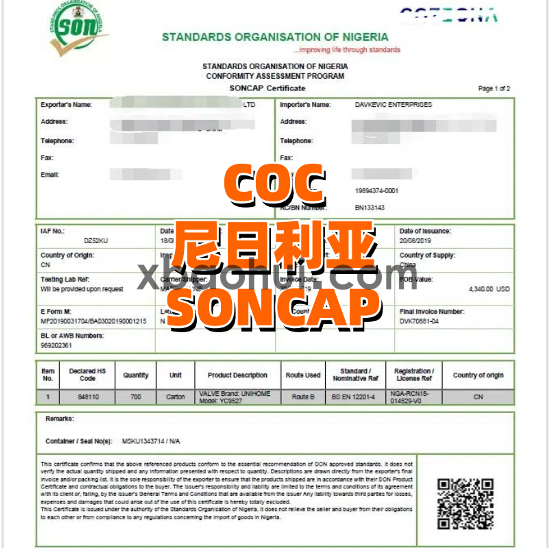
Which products require Nigeria SONCAP certification?
Except for exempted products such as food, medicine, medical consumables (except some medical equipment), military supplies, some industrial raw materials, and some second-hand products, most industrial and consumer products fall within the scope of SONCAP supervision.
Electronic and electrical products
Household appliances, LED lamps, lighting equipment, power adapters, switches, plugs and sockets, wires and cables, distribution boxes, circuit breakers, transformers, motors, generators, power tools, air conditioners, refrigerators, washing machines
Building materials
Steel, cement, ceramic tiles, ceramic products, glass, doors and windows, aluminum profiles, pipes, pipe fittings, sanitary ware, building hardware, insulation materials
Mechanical equipment
Industrial machinery, agricultural machinery, construction machinery, mining machinery, packaging machinery, food machinery, woodworking machinery, air compressors, generator sets, water pumps, fans, conveying equipment
Automobiles and spare parts
Auto parts, tires, batteries, auto lamps, auto glass, filters, braking systems, shock absorbers, bearings, engine parts
Chemical products
Paints, coatings, adhesives, detergents, lubricating oils, greases, industrial chemicals, daily chemicals
Furniture and home furnishings
Wooden furniture, metal furniture, plastic furniture, office furniture, mattresses, cabinets, tables and chairs, sofas
Textiles and leather products
Clothing, footwear, bags, textile fabrics, bedding, towels, leather products
Daily consumer goods
Kitchen supplies, tableware, cooking utensils, plastic products, stainless steel products, glassware, thermos cups, household products
Toys and children's products
Children's toys, plush toys, plastic toys, electric toys, educational toys, infant products
Personal Protective Equipment (PPE)
Safety helmet, safety shoes, protective gloves, protective glasses, protective mask, protective clothing, safety belt, reflective vest
Description: Whether it is a SONCAP regulated product should be confirmed based on the HS code, product usage and SON’s latest regulatory catalog.
Nigeria SONCAP certification application materials
Typically required:
- SONCAP application form
- Commercial Invoice
- Packing List
- Product Specification (Datasheet)
- Product manual
- Product photos
- Test Report
- CE, CB, IEC and other product certification certificates (if any)
- ISO9001 certificate (if any)
- Form M Information (Importer)
- Shipping Information
Nigeria SONCAP certification process
Step one: Apply for Product Certificate (PC)
Apply based on product status:
- PC1(Unregistered)
- PC2(Registered)
- PC3(Licensed)
↓
Step 2: Submit technical information
Review:
- HS Code
- Product Standard
- Test report
- Technical documentation
↓
Step 3: Product testing (if necessary)
If test report:
- Not meeting requirements
- Expired
- Does not meet SON requirements
laboratory testing will need to be arranged.
↓
Step 4: Inspection before shipment
Main checks:
- Product quantity
- Packaging
- tag
- Nameplate
- Product consistency
- Container loading supervision (when applicable)
↓
Step 5: Issue SONCAP Certificate (SC)
Issued after passing the review:
SONCAP Certificate(SC)
The importer handles PAAR and customs clearance with SC.
Nigeria SONCAP authentication model
Route A(PC1,Unregistered)
Applies to:
- First export
- Occasional export
- Small batch orders
Features:
- PC1 is valid for 6 months, single use only
- Each ticket needs to be tested, inspected and apply for SC
Route B(PC2,Registered)
Applies to:
- Frequently exported
- Product stability
Features:
- PC2 is valid for 1 year
- Each batch of goods still needs to apply for SC
- Can reduce duplicate detection
Route C(PC3,Licensed)
Applies to:
- Large Manufacturer
- Brand enterprise
- Long-term stable export
Features:
- PC3 is valid for 1 year
- Regular factory audits
- Overall cost depends on lot size, testing and audit requirements
- The certificate issuance time is subject to the completeness of the information and review arrangements.
Nigeria SONCAP certification timing
| Project | Reference time |
|---|---|
| File Review | 1–2 working days |
| Product testing (if required) | 5–10 working days |
| Inspection Arrangement | 1–3 working days |
| SC certificate issuance | 1–2 working days |
Under normal circumstances: 7~10 working days (when no additional testing is required).
Nigeria SONCAP certification fee
Certification fees typically include:
- Product Certificate (PC) fee
- Product testing fee
- Inspection fee
- SONCAP Certificate (SC) fee
- Document review fee
Frequently Asked Questions (FAQ)
Q1: Which products must undergo SONCAP certification?
Except for products explicitly exempted by SON, most manufactured industrial products and consumer goods imported into Nigeria require SONCAP certification.
Q2: What certificates does SONCAP include?
Includes:
- Product Certificate (PC1, PC2 or PC3)
- SONCAP Certificate(SC)
Both are important documents for the import process.
Q3: Does every shipment need to apply for SC?
Required.
Regardless of PC2 or PC3, each batch of export goods must apply for the corresponding SONCAP Certificate (SC).
Q4: How long is the PC certificate valid for?
- PC1: 6 months (single use)
- PC2: 1 year
- PC3: 1 year
Q5: Can I clear customs without a SONCAP certificate?
For regulated products, PAAR and import customs clearance cannot usually be completed without a valid SC certificate, and fines or other penalties may result.
Why choose a professional SONCAP certification service organization?
Professional certification service organizations can help companies:
- Determine whether the product falls within the scope of SONCAP supervision
- Recommend the most suitable PC certification route
- Assist in preparing technical data
- Arrange CNAS/ISO17025 laboratory testing
- Coordinate on-site inspection
- Shorten the certificate issuance timing
- Reduce customs clearance risk
- Improve the success rate of one-time certificate issuance
Summary
For manufacturers, exporters and traders who export electronic appliances, mechanical equipment, building materials, auto parts, chemical products, furniture, textiles, daily necessities and other products to Nigeria, they should confirm whether the products fall within the scope of SONCAP supervision before shipping, and prepare test reports, technical documents and inspection arrangements in advance.
And apply for Product Certificate (PC) and SONCAP Certificate (SC) in a timely manner to ensure the smooth handling of Form M, PAAR and import customs clearance of goods, reduce trade risks, and improve international trade efficiency.
Business Contact
Mr. Zhou Tel: +86 13530227809 13530227809
——END——