
Policies and versions that must be checked before processing
SGS's current China-Africa data sheet is marked with Last modification: 09/03/2026, and is a combination of assessments such as parallel documents, remote inspection, testing and factory audits; this is agency project information and does not equal the full text of government regulations. The table's 2026 Implementation Date field cannot be interpreted as indicating that the entire project was first established in 2026. Report reuse and route application must be reviewed on a case-by-case basis.
SGS China-Africa Project Data Sheet (2026 Revision Mark)
Verification date: 2026-11-14; Routine review: 2027-02-12; Announcement, version or platform changes are reviewed in advance. The above only lists the claims in a closed loop, and unapproved historical terms do not serve as current guarantees.
Home country service information and inquiry . Access World Trade(Shenzhen)Co.,Ltd, Mr. Zhou: 13530227809,+86 13530227809,Richchou.coc@gmail.com . Please provide product name, HS, cargo value, route and shipping date to check applicable requirements and quotation.
Summary
The Central African Republic Product Verification of Conformity (PVoC) project involves conformity assessment and CoC before shipment of regulated goods. PVoC is not regarded as an unapproved Chinese regulatory name.
The Central African Republic Product Verification Scheme (PVoC) requires regulated products to be verified before export. The program is administered by the Ministry of Commerce and Industry of the Central African Republic through accredited inspection agencies and requires exporters to obtain a certificate of conformity based on document review, inspection and test results.
This certificate is necessary for customs clearance and legal entry into the market. The program aims to protect consumer safety, ensure compliance, and facilitate the smooth trade of compliant products.
2. Central African Republic coc certificate template
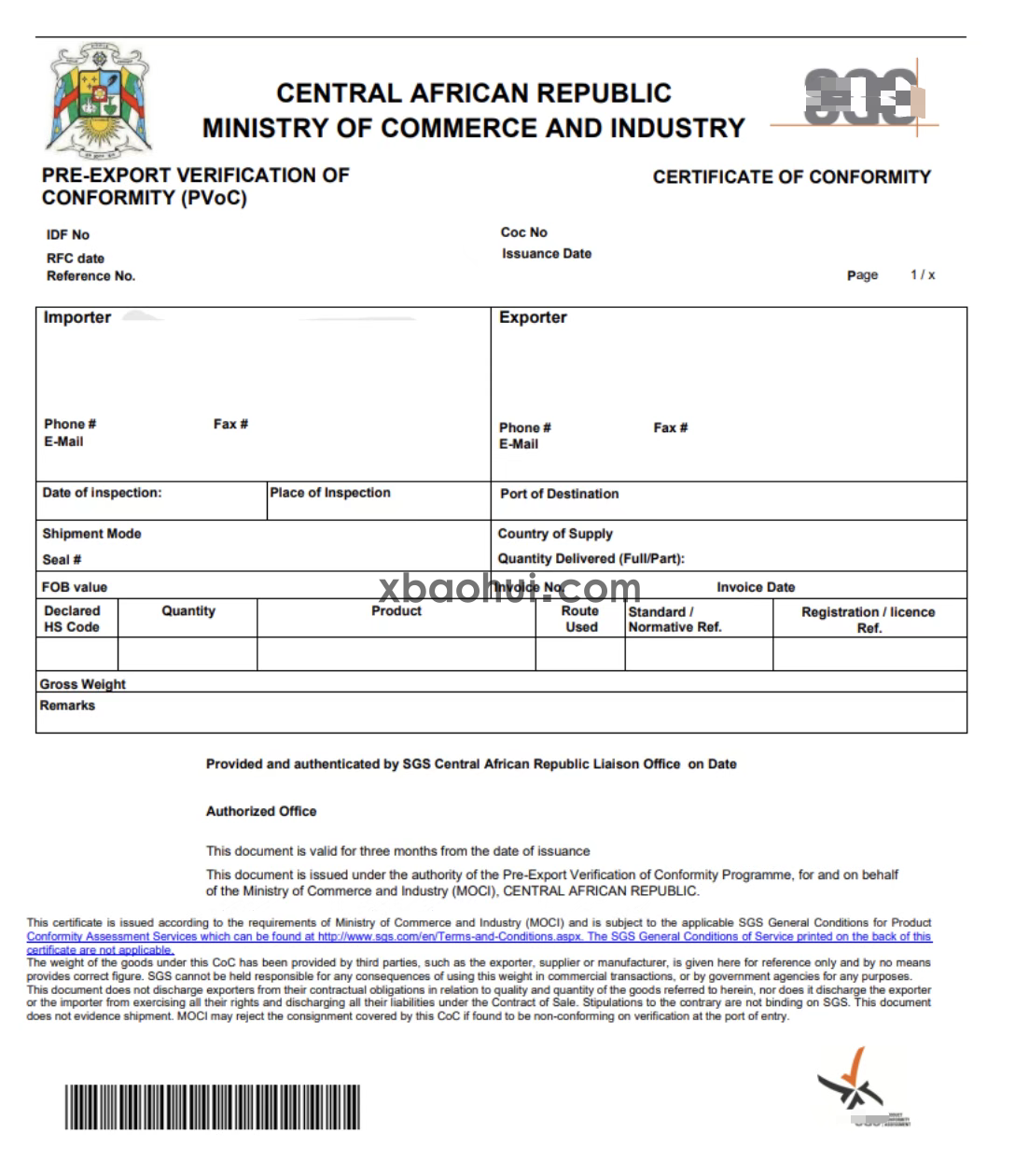
1. Purpose and Scope
The Central African Republic has a mandatory Pre-Export Verification of Conformity (PVoC) program for most imported goods. The program ensures that goods meet national or internationally recognized quality and safety standards before export. It protects consumers from unsafe or substandard products,
Support fair trade and streamline the customs clearance process for compliant goods.
2. Government agencies
The PVoC program is overseen by the Department of Commerce and Industry, which enforces technical regulations and product standards. Accredited third-party inspection agencies perform verification on behalf of the Ministry of Commerce and Industry to confirm that imported goods comply with applicable standards.
3. Certificate of Conformity (CoC)
All regulated products require a Certificate of Conformity (CoC) prior to shipment. This certificate confirms that the goods have been assessed and meet specified standards. Customs authorities will not release goods without a valid certificate of conformity, and goods without a certificate of conformity may be delayed, refused, or penalized.
4. Controlled products:
The PVoC program covers products that may pose safety, health or environmental risks, including:
Food and Beverage
Chemicals
Plastic, rubber and leather products
Wood, paper and building materials
Textiles and apparel
Electrical and electronic equipment
Industrial machinery and mechanical components
Automobiles and auto parts
Toys and sporting goods
Laboratory and scientific equipment
Furniture and furnishings
The above categories are only examples of business consultation and are not the current complete HS regulatory catalog. Whether it is controlled or meets exemption conditions should be checked based on HS, purpose, value and current project requirements. It is not automatically promised that low value goods will be exempted.
5. Conformity Assessment Process
Step 1 - Initiate Request - The exporter or his agent initiates the process by submitting product and shipment information to the designated inspection agency prior to shipment.
Step 2 - Documentation Review - The inspection agency evaluates the technical specifications, test reports, and supporting documentation to determine the applicable standards and appropriate verification pathways.
Step Three - Arrange document verification, remote or other applicable inspection, laboratory testing, or factory audit by product and applicable route. Not every batch must undergo the same on-site inspection.
Step 4 – Issuance of Certificate of Conformity – After audit, inspection and any necessary testing, a Certificate of Conformity will be issued. This certificate must accompany the goods for customs clearance.
6. Roles and Responsibilities
Exporter
Determining whether a product is regulated under the PVoC scheme
Please submit all complete documentation before shipping.
Assist with inspection and testing
Obtain a valid certificate of conformity before exporting
Importer
Ensure that arriving shipments are accompanied by a valid Certificate of Conformity (CoC).
Present the certificate to customs for clearance.
Please confirm compliance with relevant regulations before distributing goods domestically.
Failure to comply may result in cargo detention, fines, or denial of clearance.
7. Central African Republic COC certification process fee timing
Process: Submit information, review information, inspect goods, issue certificate
It is recommended to apply 1~2 weeks before shipment.
Different products have different COC certification standards and projects. It is recommended to provide the product name, type, and value for quotation.
8. Central African Republic coc certification FAQ
Q1: Is Central African Republic COC certification mandatory?
A: Yes. All goods falling within the PVoC control list must obtain a COC certificate before being sent to the Central African Republic. Otherwise, the goods will be refused customs clearance after arriving in the capital, Bangui, and may face penalties such as fines and return shipments.
Q2: How long is the COC certificate valid?
A: CoC corresponds to this batch of goods. Whether the test report can be reused must check the product model, standard version, testing scope, laboratory and agency accreditation conditions, and cannot be uniformly determined to be valid for one year.
Q3: What will happen if I arrive in Hong Kong without a COC certificate?
A: If the goods cannot produce a valid COC when they arrive at the port, they will be refused customs clearance and may be fined. In serious cases, the goods will be returned to the country. It is not recommended to take chances.
Q4: Can a COC be reissued after the goods are shipped?
A: Applicable assessments should be verified and completed before shipment; without obtaining written approval of the promissory note, there is no commitment to reissue after shipment, nor will it be inferred that this item is allowed to be reissued based on the correction rules of other countries.
Business Contact
Phone: 13530227809 Tel: +86-755-23763629
————END————