
Tax entry revision and historical travel information reminder
URA's import and export FAQ calculates customs duties, VAT and withholding tax separately in a specific vehicle example. The tax base of VAT and other taxes is not the same; this example or the sum of the two percentages cannot be generalized into a unified tax burden for all imports. URA's VAT description also distinguishes between exemptions, input tax and eligible deductions/refunds, and does not support the old article's statement that no tax refunds are allowed.
This article was originally published in 2024. Other market data, visas, expenses, health and travel paragraphs are reserved for historical reference. The current item-by-item verification has not been completed, and it does not serve as a current travel or tax calculation guide. Only the listed tax assertions are revised here and the unreviewed epidemic detection certainty requirement is removed.
URA import and export FAQ · URA VAT description
Verification of the above entries: 2026-11-12; routine review: 2027-02-10, and review in advance when the official update is made. This does not mean that all policies in the full text have been verified.
UGANDA UGANDA CUSTOMS
Import duties, import VAT, withholding taxes and other taxes should be calculated based on product classification, customs taxable price, taxpayer qualifications and exemption conditions. It cannot be assumed that 18% plus 15% is a unified tax burden of 33% for all goods or services, nor can it be concluded that all relevant taxes cannot be deducted or refunded. The specific tax rate and tax deduction/refund qualification must be determined according to the applicable regulations of URA and promissory note.
In terms of tariff barriers, Uganda is relatively competitive as an import and export market in the region. The average applicable tariff rate is 5.9%, which is the third lowest in the region, while the average level in the region is 8.8%. Uganda fares better than neighboring countries such as Rwanda, Kenya, Ethiopia and Tanzania in this respect.
In addition, Uganda has launched a "Bonded Production Plan" specifically for manufacturers, which allows manufacturers to apply for a customs license to store and use imported raw materials intended for export production in a safe place without paying taxes.
Uganda is a key player in regional integration, bilateral and international negotiations. In addition, Uganda is a founding member of the World Trade Organization and has been a member of the General Agreement on Tariffs and Trade (the predecessor of the World Trade Organization) since 1962. As a member of several multilateral trade organizations, Uganda fulfills its commitments to reduce trade barriers, especially lowering tariffs, to benefit businesses.
Uganda Customs Clearance Documents
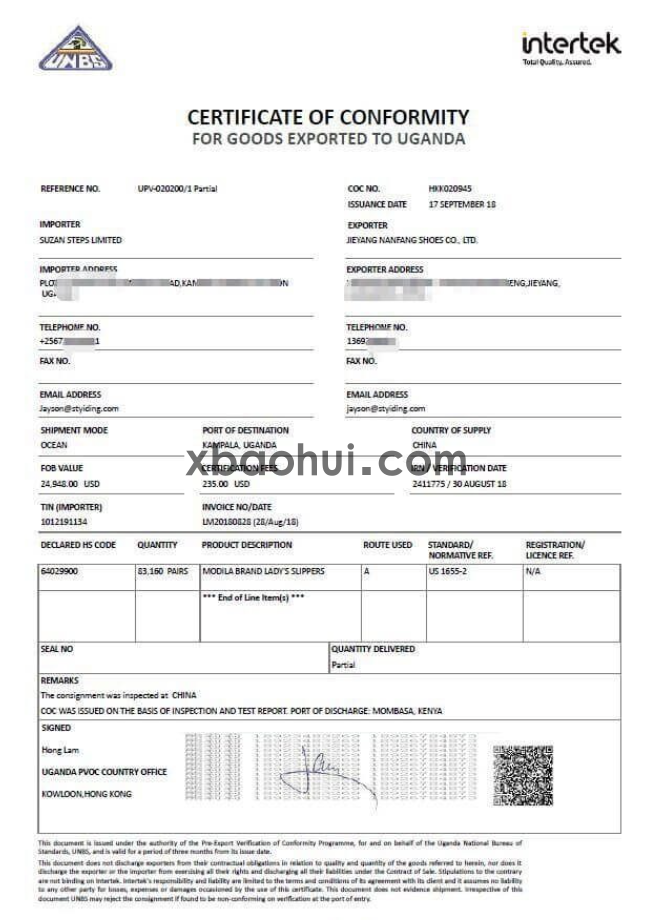
Commercial invoice, packing list, bill of lading, if approval is required, import license, contract, certificate of origin, quality inspection certificate coc, packaging statement
Uganda coc certificate
Labeling requirements for import and export goods in Uganda
Import and export goods must be clearly marked with the following information: importer/exporter name, consignee, flight/vehicle details, unloading location, package quantity, container identification, cargo description, air waybill number/bill of lading, country/region of origin/destination. Uganda requires food labeling but has not yet adopted any specific requirements.
The following items cannot be imported into Uganda:
Pornographic materials and documents
Used motor vehicle tires
Used computers and appliances
Second-hand underwear
Other categories of imports may be prohibited based on international agreements signed by Uganda.
Uganda-China relations
According to data on the website of the Economic Complexity Research Center, the export trade from mainland China to Uganda showed an upward trend from 1988 to 2012, and the proportion of mechanical products also increased at the same time; in 2012, mainland China exported more than 600 million US dollars to Uganda, including machinery products, textiles, chemical products, etc., and was Uganda's second largest source of imports that year[17]. Uganda exported more than $45 million to China in 2012, mostly animal skins and vegetable products.
In November 2008, a private enterprise in Hebei Province, China, established a free trade park in Uganda with an area of 518 square kilometers and a 99-year operation period. It will establish departments responsible for foreign affairs, police, justice and other affairs, and will enjoy local legislative power. Projects available for investment or development in the free trade park include airports, terminals, banks, TV stations, newspapers, golf courses, etc. More than 100 companies have applied to join the park, and the People's Republic of China has also promised to provide some subsidies to companies in the park.
Uganda pvoc certification
The Uganda National Bureau of Standards (UNBS) is responsible for setting and inspecting standards. UNBS sets some standards but in some cases adopts those set by others. UNBS is a member of ISO, Codex Alimentarius, International Organization of Legal Metrology and Afrinet. Uganda adopts EU directives and standards with some modifications. Importers/exporters should contact UN BS for specific information about the standards.
Uganda business culture
Ugandan businessmen value decision-making through consensus and place a high priority on developing relationships. Ugandans take etiquette very seriously and most meetings will start with an introduction, including the participants' business backgrounds and families, so all parties can feel comfortable working with each other. Therefore, business transactions take time to build the relationship between the parties. A trusted third-party introduction can make it more familiar and easier for you to contact Ugandan businesses. Before initial contact, an introduction from a mutual friend, acquaintance, or known business associate can help alleviate some of the issues before the initial correspondence or meeting. The Commercial Section of the U.S. Embassy has connections with government agencies and the business community and can facilitate introductions. Formalism is common in business transactions in Uganda. Ugandans consider it polite to address contacts by title, such as Honorable (members of parliament and ministers), Mr., Mrs., Miss, Dr., followed by the surname. Calling someone by their first name when meeting for the first time may be considered presumptuous.
Successful investing in Uganda requires a large number of business meetings, with a strong preference for face-to-face discussions by phone or email. Uganda is a hierarchical society, so investors often request initial meetings with the organization's top officials.
While introductions may be formal, business meetings tend to be informal and often lack an agenda. It is not uncommon for others to be called to the meeting after it has begun. We recommend that potential investors identify the commercial officer responsible for decision-making prior to the introductory meeting. Ugandans dress formally when attending business meetings. Normal business attire includes a suit and tie for men and a suit or dress for women. An open-collared shirt and slacks can be worn for informal meetings.
Uganda Travel Alert
Visa entry
Check passport validity. The remaining validity period of the passport should generally be more than one year, so as not to affect the visa application due to insufficient validity period of the passport, or the expiration of the passport while abroad to avoid affecting the itinerary. If your passport is valid for less than one year, please renew it as soon as possible.
Obtain the "International Certificate of Vaccination or Preventive Measures" (commonly known as the "Yellow Book"). The Ugandan Immigration Service requires travelers entering the country to provide a Yellow Fever vaccination certificate.
Visa application completed. The Uganda Immigration Service has launched a new electronic visa (E-Visa) system in September 2016 (Uganda Immigration Service E-Visa system website: https://visas.immigration.go.ug/). This system requires people coming to Uganda to submit relevant information such as passport information pages, yellow books, and passport photos on the website in advance, and pay visa fees online. After your visa is approved, you can go to the Ugandan Embassy in China, the Consulate General in Guangzhou or the Entebbe Airport in Uganda to have your fingerprints entered and get a visa sticker. Due to the inefficiency of the Ugandan immigration department, visa approval may take more than a month.
When entering or exiting the country, you must present the Yellow Fever Vaccination Book. If you do not have a residence permit in Uzbekistan, you must fill in the entry and exit card, answer the questions of the port immigration officer truthfully and accurately according to the visa type and purpose of visit, and enter your fingerprints. Afterwards, Uzbekistan Customs will inspect the luggage, and if there are no problems, it can be cleared.
This is the old information for entry testing during the epidemic. The current applicability review has not been completed, and it does not serve as the basis for the current nucleic acid report or specific testing time limit. Before traveling, please check the current requirements with the Ugandan authorities, relevant embassies and consulates and the carrier.
Special reminder: Migrant workers in Uganda must apply for a legal work permit in accordance with the relevant policies of the Uganda Immigration Bureau, and copy and scan together with personal materials such as the passport data page for emergency needs.
Uganda visa requirements: The Uganda Immigration Service requires tourists to apply for a visa online through the Uganda Electronic Visa Application System prior to arrival and present the confirmation barcode at the airport. Please apply at least three weeks before departure. According to the Uganda Embassy website (Embassy of the Republic of Uganda - Visa Requirements) Electronic Visa Permit Application System, single entry visa fee is USD 50, multiple entry visa fee is USD 100, East Africa tourist visa is valid in Uganda, Rwanda and Kenya fee is USD 100. Starting July 2022, the Ministry of Health will require proof of COVID-19 vaccination, except for children under 5 years old. Booster vaccinations are not required. Without proof of vaccination, travelers should present a negative PCR test result taken within 72 hours before travel. These guidelines are constantly changing.
Uganda Currency
The official currency of Uganda is the Uganda Shilling (UGX), which is freely traded on the open market. As of October 1, 2023, the exchange rate is UGX 3759.5 to 1 USD. Major commercial bank ATMs are located in all major towns and hotels. Real estate transactions and large import orders are conducted in U.S. dollars, while day-to-day transactions are conducted in shillings. Some hotels may accept U.S. dollars as payment, and most large hotel chains will accept credit card payments. With the exception of large hotels, large supermarkets, stores in malls, and some restaurants, few merchants accept credit cards, encouraging U.S. investors to have enough cash on hand to make transactions.
Uganda Telecom/Electronics
The largest telecommunications companies in Uganda are: MTN, Airtel, Uganda Telecom and Smile Telecom. Mobile phone networks cover cities and most rural areas, but reception quality can be spotty. SIM cards for U.S. travelers to Uganda that are compatible with tri-band phones cost less than $2 and can be purchased at authorized telecommunications bureaus. To purchase and register a new SIM card, customers must present their passport and provide a passport photo and a copy of the passport bio page. Satellite phones are recommended for those working in remote areas. US mobile phones can work in roaming mode in Uganda. T-Mobile's international services are provided through partnerships with local networks. Google Project Fi also works with local networks. Wi-Fi is available in major hotels across Uganda, but speeds may vary.
Electrical sockets in Uganda operate at 220 watts using a Type G plug. Uganda's power distribution network is underdeveloped, resulting in frequent power surges. Travelers are strongly advised to use a surge protector.
Ugandans, especially those in urban areas, are increasingly relying on WhatsApp text messages as the primary method of communication for personal and business needs. Many Ugandans rarely check email and often miss messages. Fax and photocopying services are available in Kampala shops and major hotels.
Uganda Logistics and Transportation
Although the government has invested heavily in the country's road network and several major highways have been improved, many roads are in poor condition and fatal accidents have increased. Paved roads connect Kampala with border crossings in Kenya, Rwanda, South Sudan, the Democratic Republic of Congo (DRC) and Tanzania. Uganda's first four-lane highway opened in June 2018, connecting Kampala and Entebbe. Driving conditions deteriorate during the rainy season due to poor drainage. As Kampala’s vehicle population increases by 10% annually, unpredictable traffic congestion continues to worsen. A regular trip through Kampala can take anywhere from 30 minutes to two hours. Secondary roads across the country are undeveloped and the use of high-clearance vehicles is strongly recommended.
Uganda’s public transportation system is unreliable and dangerous. Fourteen-seat commuter buses (known locally as "taxi" or "matatus") are used for intra-city and long-distance travel. These buses are neither safe nor reliable due to poorly maintained vehicles, poor road conditions and aggressive driving. The larger 62-seater buses are also used for long-distance journeys, but concerns have been raised about their safety after speeding and reckless driving led to accidents on major highways. Motorcycle taxis (known locally as "boda-bodas") are common and considered dangerous because most drivers are unlicensed and many drive recklessly. In fact, it is estimated that approximately 60% of hospital admissions in Kampala are due to boda-boda related accidents. Uber has become a popular mode of transportation and is considered safe to use.
Uganda Airport
Entebbe International Airport offers direct flights to regional, European and Middle Eastern destinations. Frequent regional flights include Nairobi, Mombasa, Dar es Salaam, Zanzibar, Addis Ababa, Juba, Mogadishu, Kinshasa, Bujumbura and Kigali. Other direct international destinations include Johannesburg, Cairo, Istanbul, Dubai, Doha, Brussels and Amsterdam. Delta and United have no direct flights to the United States, although they codeshare with airlines in Europe, Africa and the Middle East. Small private airlines have recently established regular commercial services between Entebbe and several domestic hunting sites popular with tourists. Uganda relaunched its national airline (Uganda Airways) in July 2019 with four Bombardier CRJ900 aircraft operating on routes in East and Central Africa. The airline has also purchased two Airbus A330neo aircraft for delivery in December 2020 and February 2021, with the aim of extending the airline's routes to Europe, the Middle East and China. Uganda Airlines has direct flights to Dubai and has not yet launched flights to London and Guangzhou.
Ugandan Language
English (British English) is the official language of Uganda. Bantu languages dominate the area south of Lake Kioga, while Nilotic languages dominate in the north. Swahili is commonly spoken near Uganda's borders with Kenya, Tanzania and the Democratic Republic of Congo.
Uganda Healthcare
Travelers are encouraged to bring their own medical supplies as some medications are either not available in Uganda or are only available in generic form. According to the World Health Organization, Uganda has administered at least 23.9 million doses of COVID-19 vaccines as of July 2022, of which 12 million have been fully vaccinated, covering only about 25.4% of the country's population. From June 2022, the Ministry of Health requires all travelers on inbound and outbound travel to and from Uganda to be fully vaccinated and to undergo a COVID-19 test at an approved facility within 72 hours before departure (if not fully vaccinated). Malaria is widespread and the use of appropriate precautions and bed nets is highly recommended to reduce the risk of contracting malaria. Vaccinations against typhoid, hepatitis A and B, and meningococcal vaccines are also recommended. Yellow fever is particularly common in northern Uganda but can be reliably prevented with the required yellow fever vaccine. Uganda requires proof of yellow fever immunity to enter the country. Be sure to have the yellow fever immunity stamp appropriately stamped on your immunity card. Due to poor sanitation across Uganda, enteric diseases such as E. coli, Giardia, amoebic dysentery and Shigella are common. Travelers should avoid eating roadside food and are encouraged to drink bottled water, as typhoid and cholera outbreaks are common. Although tap water is treated, tap water is not potable and should be boiled for five minutes and filtered before drinking. If eating fruits and vegetables raw, soak them in chlorinated water for 20 minutes. Most lakes and rivers are infected with schistosomiasis, limiting water recreation. Restaurant food should be hot and cooked. Undercooked food, salads and fruits without skins should be avoided as they may lead to intestinal disorders. Contact with stray animals, including cats and dogs, should be avoided as they may carry rabies. Adult HIV prevalence is approximately 6.2% (7.6% among women and 4.7% among men). Prevalence is much higher in major cities and regions that rely on cross-border trade.
What ports are there in Uganda?
Jinja Port (UGJIN)
Mbale Port (UGMBA)
Port of Arua (UGRUA)
Bugembe Port (UGBUG)
Port of Busia (UGBUS)
Port of Entebbe (UGEBB)
Port of Portalburg (UGFPO)
UGULU
Chinese Embassy in Uganda
Ambassador: Zhang Lizhong
Address: 37, MALCOLM X AVENUE, KOLOLO, KAMPALA, UGANDA
Mailbox: P.O.BOX 4106, KAMPALA, UGANDA
Tel: 00256-41-4-259881 (office)
00256-41-4-236895 (Consular Department)
Fax: 00256-41-4-254456
Website: http://ug.china-embassy.gov.cn
Email: chinaemb_ug@mfa.gov.cn
There are 12 airports in Uganda, namely:
Arua Airport (RUA) Entebbe Airport (EBB)
Gulu Airport (ULU)Kampala Airport (JIN)
Kabalega Falls Airport (KBG)
Kasese Airport (KSE)
Masindi Airport (KCU)
Mbarara Airport (MBQ)
Moyo Airport (OYG)
Pakuba Airport (PAF)
Soroti Airport (SRT)
Tororo Airport (TRY)
Related links:
Export to Uganda PVoC COC certification
Export to Uganda market overview, challenges and opportunities
————END————