
Introduction: Kenya is the financial and logistics hub of East Africa and an important market for Chinese companies exporting to Africa. However, many foreign traders are stuck in customs clearance documents, PVoC compliance certification and ICMIS declaration when it is their first time to make goods from Kenya.
Based on the import and export procedures disclosed by Kenyan customs and competent authorities, this article compiles the documents, declaration forms and step-by-step checklist required for the entire import and export process into a guide that can be directly compared and implemented.
1. Importing to Kenya: Documents required for customs clearance
Customs clearance of any imported goods (automobiles, machinery and equipment or general commodities) must be entrusted Licensed Customs Clearance Agent Handled. When working with a customs clearance agent, the following documents should always be provided (including but not limited to):
- Regulated products must have a certificate issued by a PVoC agent Certificate of Conformity (CoC) ;
- If applicable, obtain Import Standard Mark (ISM) ;
- Valid commercial invoice issued by the exporter;
- Valid proforma invoice issued by the exporter;
- Bill of lading (sea cargo)/air waybill (air cargo);
- Certificate of Origin;
- Ocean cargo freight invoice;
- Vehicle registration manual; if it is not in English, an English translation must be attached (motor vehicle);
- Permits/Licenses for Restricted Goods;
- Personal or Taxpayer Identification Number (PIN Certificate);
- Tax exemption letter (when the goods are tax exempt);
- Purchase Order/Contract;
- Motor vehicle road qualification certificate;
- Packing list;
Letter of Credit (if any).
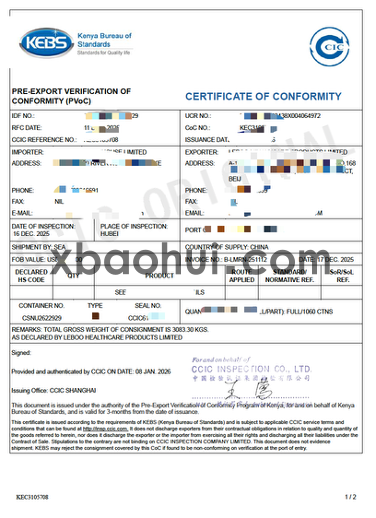
Kenya COC Certificate Template Pvoc
1. Key forms and documents for import declaration
- Import Declaration Form (IDF, Form C-61) : A processing fee is required, with a minimum of KShs 5,000, or 2.75% of the CIF price.
- Customs Value Declaration (Form C-52) : Issued by the Customs Service. The importer must fill out and sign the form to declare the true and accurate value of the imported goods.
Compliance Certificate : According to the requirements of Kenya Bureau of Standards (KEBS), Kenya Plant Health Inspection Service (KEPHIS) and other competent authorities, such as certificate of analysis, phytosanitary certificate, etc.
This type of certificate is issued by the competent authority of the supplier's country after inspecting the goods.
Release Order : Issued by the Port Authority. After verification and payment of storage fees and other possible expenses, the goods can be released to the importer or its agent for safekeeping.
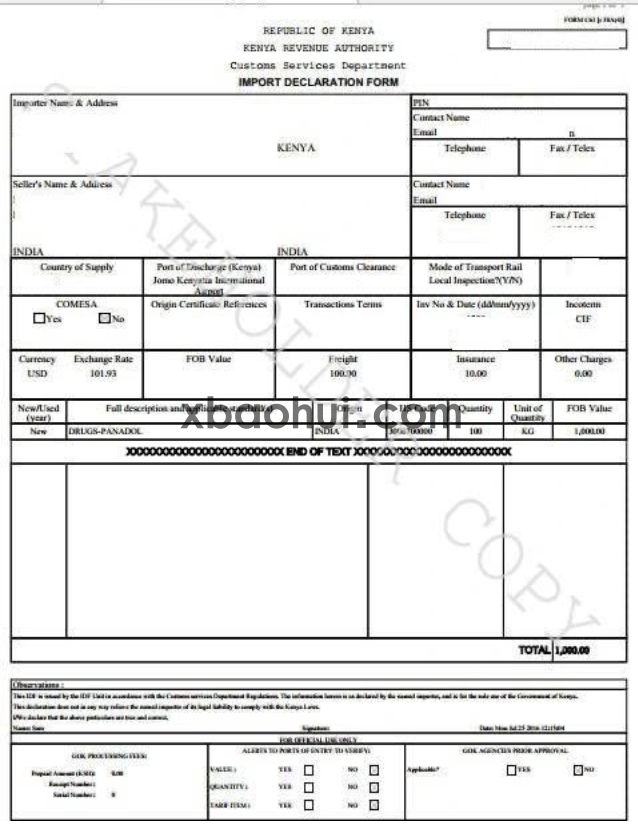
Kenya IDF Template
2. Declaration using ICMIS system
It is recommended to entrust a customs clearance agent to assist in the preparation of customs documents. Kenya Revenue Authority (KRA) launches new cargo declaration and tracking system – Integrated Customs Management System (ICMIS) , has replaced the older SIMBA TradeX system.
Only customs clearance agents who have been trained and registered by the customs can log in to the system; you need to provide them with the original documents received from the supplier, which will be verified by the customs clearance agent and then submitted to the customs service office.
2. Step-by-step import process
Before placing the order
| Steps | Activity | Docking department | Issue documents/references |
|---|---|---|---|
| Step 1 | Make sure you have applied for a trade license | Ministry of Industry and Trade (MoTI) | License |
| Step 2 | Ensure an import license is obtained if necessary | Kenya Revenue Authority (KRA) | License |
| Step 3 | If it is a food, drug or chemical substance, obtain a license if necessary | Port Health Office; Pharmacy and Poison Administration | License |
| Step 4 | Agricultural products: Obtain plant import licenses; determine phytosanitary requirements and communicate with suppliers | Kenya Plant Health Inspection Service (KEPHIS) | Licensing; phytosanitary requirements |
| Step 5 | Determine Kenyan standards for products to be imported and inform suppliers/exporters | Kenya Bureau of Standards (KEBS) | Standard specification |
| Step 6 | Determine the goods to be imported: description, quality, specifications, quantity | Enterprise | Specifications |
| Step 7 | Send information to identified suppliers to clarify: description of goods, technical specifications, Kenyan standards, phytosanitary requirements, quantity, price, delivery time | Enterprise | Specifications |
| Step 8 | Verify that the goods are not prohibited or restricted from import | Kenya Revenue Authority (KRA) | Schedule 2 of the EAC Customs Administration Law |
| Step 9 | Check whether goods are tax-free | Kenya Revenue Authority (KRA) | Schedule 5 of the EAC Customs Act |
| Step 10 | Verify whether goods are subject to countervailing duties and/or anti-dumping duties | Kenya Revenue Authority (KRA) | "EAC Customs Administration Law" |
| Step 11 | Determine the cost of goods to be imported | Enterprise | Cost Calculation Sheet |
| Step 12 | Arrange funding sources (internal or external) | Enterprise; Bank | Funding has been secured |
| Step 13 | Consult your bank for advice on how to deal with suppliers | Bank | Financial Advice |
Importer places order
| Steps | Activity | Docking department | Issue documents |
|---|---|---|---|
| 1 | Negotiate terms and sign contract with selected supplier | Supplier | Contract; Order |
| 2 | Tell the supplier which bank you will use | Enterprise | Bank Name |
| 3 | Arrange payment as agreed in the contract | Enterprise | Payment suggestions |
Before the goods arrive at the port
| Steps | Activity | Docking department |
|---|---|---|
| 1 | Obtain documents required by the bank: commercial invoice, packing list, bill of lading/airway bill, certificate of compliance | Enterprise |
| 2 | Designated customs clearance agent | KIFWA |
| 3 | The customs clearance agent calculates the required duties, port charges and transportation charges and informs you | Customs clearance agent |
| 4 | Customs clearance agent arranges transportation of goods to your premises | Transporter |
| 5 | The customs clearance agent electronically enters the customs declaration, pays the tax at the bank and submits the accompanying documents to the customs | Customs Clearance Agent; Kenya Revenue Authority (KRA) |
| 6 | Ensure that the relevant quality certificates of the goods are prepared and submit them to the customs clearance agent for customs clearance to KEBS | Kenya Bureau of Standards (KEBS) |
| 7 | When necessary, customs clearance agent handles customs clearance with KEPHIS | Kenya Plant Health Inspection Service (KEPHIS) |
| 8 | When necessary, the customs clearance agent handles customs clearance with the Port Health Office | Port Health Office |
After the goods arrive at the port
| Steps | Activity | Docking department |
|---|---|---|
| 1 | Customs audit document | Kenya Revenue Authority (KRA) |
| 2 | Issuance of Release Notes | Kenya Revenue Authority (KRA) |
| 3 | Verify relevant quality certificates and release goods | Kenya Bureau of Standards (KEBS) |
| 4 | After payment of port fees, the goods are released to the importer or customs clearance agent | Kenya Ports Authority (KPA) |
| 5 | Pick up and ship goods | Transporter |
| 6 | Goods delivered to your premises | — |
- Be sure to find a licensed customs clearance agent : The ICMIS system is only open to registered and customs-trained agents, and importers cannot declare on their own.
- Controlled products need to apply for PVoC/CoC first : Products must be inspected in the country of shipment and obtain a certificate of compliance before shipment. If the certificate is missing after arrival at the port, the product will be returned or detained.
- Obtain certificates for plants, food and medicines in advance : Connect with KEPHIS, Port Health Office, Pharmacy and Poison Administration respectively. Don’t wait for the goods to arrive at the port.
Kenya import process FAQ
Q1: Do I need to find a customs clearance agent to import goods to Kenya?
Yes. Customs clearance of any imported goods (cars, machinery, general merchandise) must be entrusted to a licensed customs clearance agent. The ICMIS system of the Kenya Revenue Authority (KRA) is only open to registered and customs-trained customs clearance agents, and importers cannot declare on their own.
Q2: What documents are needed for import customs clearance in Kenya?
Core documents include: Certificate of Conformity (CoC, controlled products) issued by PVoC agent, Import Standard Mark (ISM, if applicable), commercial invoice, proforma invoice, bill of lading/air waybill, certificate of origin, packing list, bill of lading/air waybill, permit/license (restricted goods), PIN taxpayer identification number certificate, purchase contract, letter of credit, etc. Motor vehicles also need a vehicle registration manual and its English translation, and a vehicle road qualification certificate.
Q3: What are PVoC and CoC? Which products must be purchased?
PVoC (Pre-Export Verification of Conformity, pre-export compliance verification) is a pre-shipment inspection done in the shipping country. Regulated products must be issued a Certificate of Conformity (CoC) by a PVoC agent before they can be shipped; if the certificate is missing at the port, the product will be detained or returned. Applicable products may also be required to bear an Import Standard Mark (ISM).
Q4: How much does the IDF Import Declaration Form (Form C-61) cost?
When importing, you need to fill in the Import Declaration Form (IDF, Form C-61), and the handling fee is a minimum of KShs 5,000, or 2.75% of the CIF value, whichever is higher.
Q5: What is the C-52 table?
C-52 is the "Customs Value Declaration", issued by the Customs Service. The importer must fill in and sign and truthfully declare the value of the imported goods as the basis for customs valuation and taxation.
Q6: What system is ICMIS? What is the difference from the previous SIMBA TradeX?
ICMIS is an integrated customs management system (Integrated Customs Management System) launched by KRA. It is used for electronic declaration and full tracking of goods. It has replaced the old SIMBA TradeX system. The registered customs clearance agent logs in and operates, and the importer only needs to provide the original documents.
Q7: Do I need additional certificates to import food, medicines and chemicals?
Yes. If it is food, medicine or chemical substances, you need to apply for the corresponding permission from the Port Health Office, Pharmacy and Poison Administration before shipment, and you cannot wait for the goods to be replenished.
Q8: What certificates are required to import agricultural products or plant products into Kenya?
Agricultural products must apply for a plant import license issued by the Kenya Plant Health Inspection Service (KEPHIS), confirm phytosanitary requirements in advance, and communicate with suppliers. At the same time, quality certificates must be prepared in accordance with the product standards of the Kenya Bureau of Standards (KEBS).
Q9: What are the steps for customs clearance after the goods arrive at the port?
Before arriving at the port: Obtain bank documents, designate customs clearance agents, calculate customs duties and port fees, electronically enter customs declarations to pay taxes, and handle KEBS/KEPHIS/port health procedures. After arriving at the port: Customs reviews the document → issues a release note → KEBS verifies the quality certificate → releases the goods after paying the port fee → picks up the goods and transports them to the warehouse.
Q10: How to confirm whether my goods are tax-free or subject to anti-dumping duties?
Before placing an order, you should check with KRA: whether the goods are on the prohibited/restricted import list (Schedule 2 of the EAC Customs Administration Law), whether they are tax-free (Schedule 5), and whether they involve countervailing duties or anti-dumping duties.
Q11: Where to pay import duties and port fees?
The customs clearance agent pays the tax at the bank and submits the accompanying documents to the customs; port fees are collected by the Port Authority (KPA) and the goods can be released to the importer or customs clearance agent only after payment.
Q12: What are the most common pitfalls when importing from Kenya for the first time?
Three high-frequency pitfalls: ① The controlled products did not apply for PVoC/CoC in advance and were detained at the port; ② The food, agricultural products, and medicines did not obtain the corresponding licenses in advance; ③ They found an unqualified "customs clearance agent" and were unable to log in to ICMIS to declare. It is recommended to confirm the trade license and import license before placing an order.
Business Contact
Mr. Zhou Tel: +86 13530227809 13530227809
____END___