
Release date: October 25, 2026 | Policy verification date: October 25, 2026
Latest policy reminder: On September 22, 2026, the South African government officially withdrew the previously proposed PVoC certification directive for some imported products from China. Currently, the PVoC system is no longer implemented as a compulsory import certification requirement.
Chinese exporters still need to check South Africa’s existing NRCS mandatory specifications, LOA licenses, SABS standards and other special import regulatory requirements based on specific product categories.
This article introduces the policy background of PVoC certification in South Africa, the original proposed controlled products, COC application procedures, certification fees, processing timing and actual customs clearance requirements after the policy is withdrawn, to help Chinese manufacturers, traders and South African importers accurately judge product compliance obligations.
1. What is PVoC certification in South Africa?
PVoC stands for Pre-Export Verification of Conformity, which is usually called "Pre-Export Conformity Verification" in Chinese.
The basic principle of this system is to verify whether the goods comply with the applicable technical standards of the importing country through technical document review, product testing and necessary cargo inspection before the goods are exported.
Goods that meet the requirements can usually obtain a Certificate of Conformity (CoC), that is, a Certificate of Conformity.
1. Why does South Africa plan to implement PVoC?
South Africa’s originally proposed PVoC regime aimed to:
Strengthen import quality supervision of high-risk consumer goods;
Reduce the risk of unsafe or substandard products entering the market;
Promote compliance verification of some products in exporting countries;
Improve the consistency of imported goods with the South African National Standards (SANS);
Reduce the impact of substandard goods on consumers and the market.
This system was proposed by the South African Department of Trade, Industry and Competition (DTIC), and the South African Bureau of Standards (SABS) is responsible for the relevant implementation planning.
2. What is the relationship between PVoC and COC?
PVoC is a pre-export conformity verification system, and COC is a certificate of conformity.
According to the original plan announced in March 2026, controlled products need to complete applicable conformity assessments before export and obtain relevant COC certificates to support import declarations.
However, the original PVoC directive has been officially withdrawn on September 22, 2026.
Therefore, the COC under the proposed system cannot currently be expressed as a valid mandatory certificate that must be processed for all relevant goods exported to South Africa.
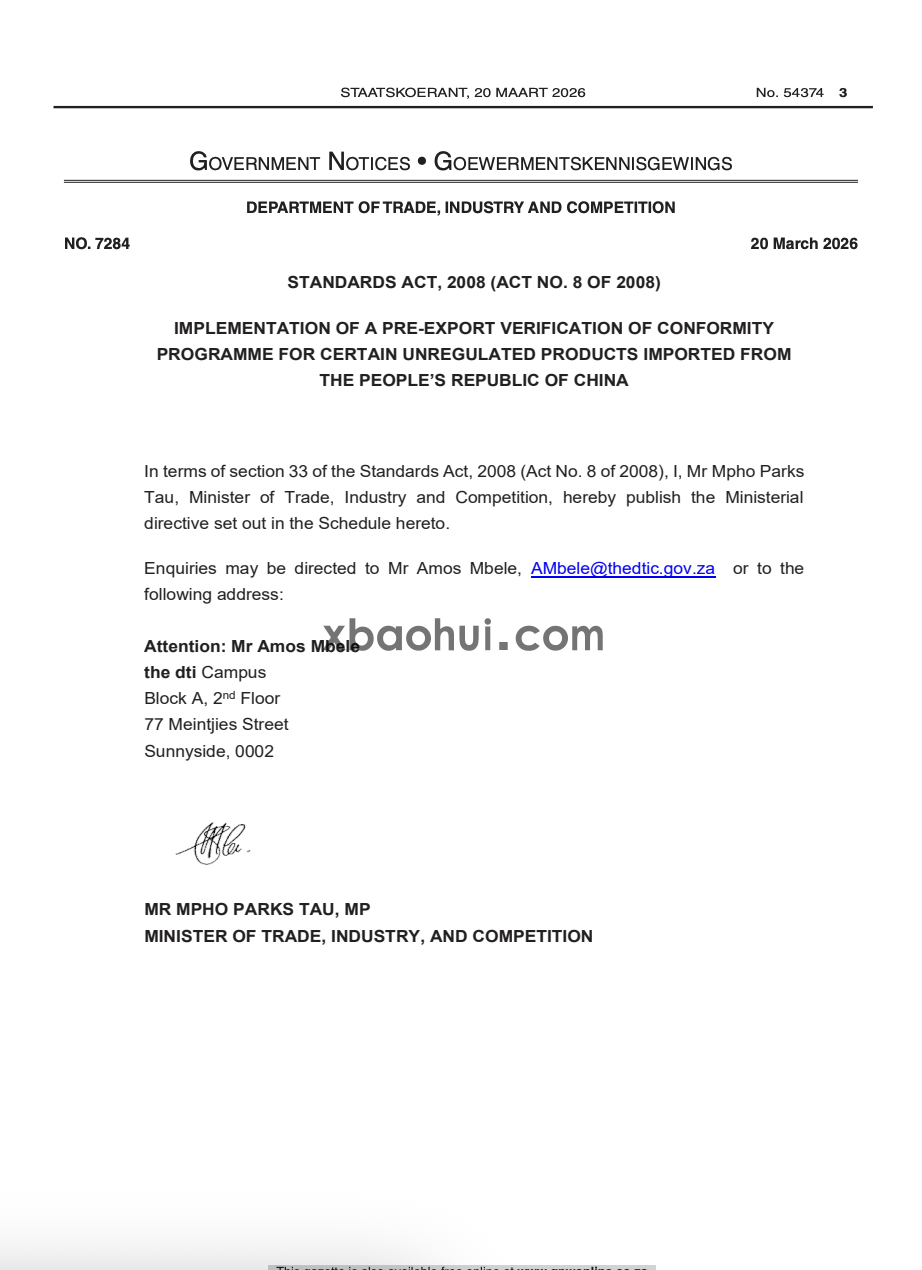
Ministerial Order on the Implementation of a Pre-shipment Conformity Verification Program for Certain Non-Regulated Products Imported from the People’s Republic of China
2. South Africa’s latest PVoC policy in 2026: from launch to official withdrawal
South Africa PVoC certification is one of the trade compliance policies that Chinese export companies will pay special attention to in 2026.
Since the policy has undergone many important changes within half a year, export companies need to distinguish four different stages of policy announcement, pilot, suspension and withdrawal.
1. March 20, 2026: Official announcement of PVoC Ministerial Directive
The South African government issued Government Gazette No. 54374, which involves the implementation of the PVoC system for some non-mandatory regulated products imported from China under the Standards Act 2008.
The original plan requires that the relevant products comply with applicable SANS standards or recognized reference standards and obtain corresponding certificates of compliance.
was originally planned to be implemented six months after publication.
2. April 1, 2026: SABS announced the first phase of the pilot plan
SABS issued a Phase 1 PVoC project notice introducing pilot arrangements, stakeholder responsibilities, pre-export verification and proposed transition procedures.
The initial pilot focuses on specific products from China.
The relevant implementation information mentions the technical cooperation arrangement with China Certification and Inspection Group (CCIC), but this does not mean that all CCIC inspection services automatically have the effect of South Africa PVoC compulsory certification.
3. June 2026: Suspension of implementation
SABS and DTIC have decided to suspend implementation activities of the proposed PVoC system in order to conduct further consultation and review under the WTO technical barriers to trade framework.
Related registration, inspection, verification, certification and implementation preparations are suspended during this period.
4. September 22, 2026: Official withdrawal of ministerial directive
The South African government, through Government Gazette No. 55432 and Government Notice No. 7947, has withdrawn the previous PVoC Ministerial Directive on some imported products from China.
Practical impacts include:
The original proposed PVoC mandatory certification requirement is no longer in effect;
Enterprises should no longer apply for new mandatory PVoC certificates according to the original directive;
The COC under the original directive will no longer be used as a new mandatory supporting document for imported goods;
Existing NRCS mandatory specifications and other regulatory systems continue to apply;
If a new similar system is launched in the future, the specific legal basis and implementation date need to be re-checked.
Conclusion: As of 25 October 2026, South Africa’s proposed PVoC regime for 2026 has been withdrawn, rather than simply postponed to the new enforcement date.
3. What are the products originally proposed to be controlled by PVoC certification in South Africa?
The proposed system in March 2026 targets some high-risk imported products that are not yet subject to the existing mandatory regulations of the NRCS.
The key risk areas mentioned in SABS's early materials include electrical and electronic products, children's products, furniture, mattresses and other consumer products.
The following table is only used to explain the product risk areas covered by the original proposed policy, and is not the currently effective mandatory PVoC control list.
| Product Category | Representative products | Key Compliance Risks |
|---|---|---|
| Electrical and electronic consumer goods | Some small household appliances and electronic equipment | Electrical safety, fire risk |
| Toys and children's products | Some toys and products for children | Mechanical, chemical and material safety |
| Furniture products | Some furniture and household items | Structural safety, material performance |
| Mattress and software products | Some mattresses and upholstered furniture | Flammability, product safety |
| Other consumer products | Other products covered by the proposed list | Relevant SANS standard requirements |
How to confirm whether a product requires South African import certification?
Although the PVoC directive has been withdrawn, this does not mean that products exported to South Africa do not require any certification or licensing.
Chinese exporters should still conduct the following verifications:
Step 1: Confirm product information.
Prepare the product’s English name, specifications and models, uses, materials, technical parameters and HS code.
Step 2: Verify the NRCS mandatory specifications.
Confirm if the product is regulated by the National Compulsory Regulatory Authority of South Africa (NRCS).
Step 3: Determine whether LOA is required.
For applicable products, confirm whether a Letter of Authority (LOA) or other mandatory approval document is required.
Step 4: Verify other special supervision systems.
Depending on the product, there may also be requirements for telecommunications equipment, agricultural products, food, chemicals, vehicles, energy efficiency, or other special requirements.
Step 5: Confirm declaration and customs clearance documents with the South African importer.
Before arranging booking, verify product applicable requirements and required documents at the destination port.
4. The original proposed COC application process for PVoC certification in South Africa
Important note: The following procedure is used to explain the original proposed PVoC scheme in 2026, and is not the current compulsory certification business process that can be directly applied for.
According to the early SABS plan, the original PVoC process can be summarized into the following seven links.
Step 1: Confirm whether the product falls within the PVoC scope
Verify product name, usage, HS code, and whether related products are included in the proposed control list.
Also identifies applicable South African National Standards (SANS) and related reference standards.
Step 2: Prepare COC application materials
Proposed applications generally require the following information:
Commercial Invoice;
Packing List;
Product name, model and detailed technical specifications;
Manufacturer and exporter information;
Product photos and packaging identification;
Applicable product test report;
Other documentation of compliance.
Step 3: Submit application
Submit information to the designated conformity assessment service agency according to the proposed certification procedure and conduct document pre-review.
Step 4: Carry out product testing and compliance evaluation
Review products for compliance with applicable SANS standards or recognized reference standards.
Whether existing test reports can be used needs to be judged based on standards consistency, test items, laboratory accreditation qualifications and other conditions.
Step 5: Arrange pre-export inspection
For goods requiring on-site inspection, the proposed arrangements include verification of:
Product name, specifications and model;
Actual quantity and packaging;
Labeling and product identification;
Consistency of goods and declaration documents;
Required sampling and compliance information.
Step 6: Review and issue COC certificate
If the products and goods meet the relevant requirements, the proposed plan will issue a Certificate of Conformity.
Step 7: Cooperate with import customs clearance
The original plan planned to use COC as a supporting document for the import of controlled goods, and to be verified by relevant customs and border management departments within the existing legal framework.
The above mandatory PVoC process is currently no longer implemented due to the withdrawal decision on September 22, 2026. Enterprises cannot directly use PVoC certificates from other African countries to replace the current requirements in South Africa.
5. How much is the PVoC certification fee in South Africa?
As of October 25, 2026, since the original PVoC system has been officially withdrawn, There is no unified mandatory PVoC certification fee standard for normal implementation based on the withdrawn order. 。
For historical PVoC quotations that appear on the Internet, companies should verify their release time, applicable system and charging basis to avoid mistaking them for the currently valid South African government mandatory charges.
If a similar PVoC system is implemented in the future, what might the fees include?
Judging from the general implementation method of pre-export conformity assessment, the following items may be involved:
| Expense items | Influencing factors |
|---|---|
| Application and document review | Product category, complexity of application materials |
| Product Testing | Applicable standards, test items and test quantity |
| On-site inspection | Inspection location, quantity of goods, inspection workload |
| Certificate issuance | Actual certification system and charging rules |
| Recheck | Cargo rectification and re-inspection requirements |
| Technical Service | Data preparation, standard verification and application assistance |
These are only possible cost components and do not represent the current official charges for PVoC in South Africa.
What are the current actual compliance fees for exporting to South Africa?
For products that are still subject to regulation, actual costs may include NRCS-related approvals, product testing, LOA applications, import licenses, or other specialized technical service fees.
There are differences in charging items and processing conditions for different products, and the corresponding competent authorities and formal application requirements should prevail.
6. How long does it take to process PVoC certification in South Africa?
Since the proposed PVoC system in 2026 has been withdrawn, there is currently no unified and effective compulsory certification processing timing under this system.
Companies should not continue to promise customers that South African PVoC certificates can be issued within a fixed number of days based on early pilot notices or certification experience in other African countries.
How should compliance time be arranged when exporting to South Africa?
It is recommended that compliance preparation be divided into four phases:
Phase 1: Product classification and regulatory verification
Confirm applicable regulatory requirements based on product technical parameters, HS code and usage.
Phase 2: Testing and data preparation
If the product involves NRCS mandatory specifications or other special licenses, test reports and related technical documents should be prepared in advance.
The third stage: Apply for the corresponding license or certificate
Complete relevant formalities through applicable government or authorized channels.
Phase 4: Check shipping and customs clearance documents
Before arranging formal shipment, confirm that the required certificates, import licenses, commercial invoices, packing lists and shipping information have met customs clearance requirements.
The time for product testing and competent authority review may affect the overall timing. It is recommended to make a shipping plan with the South African importer in advance.
7. What is the difference between South Africa’s PVoC and SABS, NRCS, and LOA certification?
These names often appear in South African import compliance inquiries, but they represent different agencies, systems or document types.
| Name | Full English name | Main function |
|---|---|---|
| PVoC | Pre-Export Verification of Conformity | Pre-export compliance verification; proposed 2026 directive withdrawn |
| SABS | South African Bureau of Standards | South African Bureau of Standards, responsible for national standardization and related conformity assessment services |
| NRCS | National Regulator for Compulsory Specifications | South African National Mandatory Regulation Regulatory Agency |
| LOA | Letter of Authority | Authorization or approval document for the applicable product |
| SANS | South African National Standards | South African National Standard |
| COC | Certificate of Conformity | Common name for Certificate of Conformity, not equivalent to all import licenses |
1. What is the difference between SABS and NRCS?
SABS is mainly responsible for South African standard formulation, standardization and related testing and certification services.
NRCS is responsible for the supervision and enforcement of mandatory product specifications within its legal scope.
Compliance with SANS standards is not the same concept as obtaining applicable NRCS approval documents.
2. What is South Africa LOA certification?
The full name of LOA is Letter of Authority, which is usually called "South Africa LOA certification" by Chinese export companies.
It is actually a regulatory approval document for the applicable product and should not be simply understood as a quality certificate common to all products.
For example, South Africa's NRCS vehicle import regulations require qualified imported vehicles to obtain an LOA.
3. Can the original PVoC replace the NRCS LOA?
No.
The original PVoC Ministerial Directive explicitly excluded products already regulated by NRCS mandatory specifications from the proposed scope.
Even if the original PVoC system is continued, the PVoC certificate cannot be directly regarded as a substitute document for the NRCS LOA.
After the current PVoC directive is withdrawn, the original NRCS related requirements are still valid.
8. COC and import customs clearance requirements for export to South Africa
For Chinese exporters, the most critical issue is not whether all goods require the same COC, but whether specific products are controlled by South Africa’s current import regulations.
1. What customs clearance documents are generally required for exporting to South Africa?
| File | English name | Main purpose |
|---|---|---|
| Commercial invoice | Commercial Invoice | Commodity declaration, trade amount and value |
| Packing list | Packing List | Packaging, quantity and weight verification |
| Ocean bill of lading or air waybill | Bill of Lading / Air Waybill | Shipping and Cargo Pickup |
| Certificate of Origin | Certificate of Origin | Prove the origin of goods when applicable |
| Customs declaration information | Customs Declaration | South Africa import declaration |
| NRCS LOA | Letter of Authority | Approval documents for regulated products |
| Other import licenses | Import Permit | Import controls on specific goods apply |
| Other special certification documents | Applicable Compliance Documents | Meet product compliance requirements of relevant departments |
Whether a certificate of origin, LOA or other license is required should be determined by commodity category, import policy and specific trade arrangements.
2. After South Africa’s PVoC is withdrawn, is a COC still needed?
One cannot generalize.
The decision to withdraw in 2026 means that the proposed new COC requirements under the original PVoC system will no longer be implemented.
However, for products subject to other regulations, different forms of compliance certification, test reports, certification or regulatory approval documents may still be required.
For example, specific products involving electromagnetic compatibility requirements may be subject to SABS-related EMC conformity assessment arrangements.
It cannot be considered that South Africa has canceled all COC documents.
3. What are the main import ports in South Africa?
China’s seaborne goods exported to South Africa often enter through the following major ports:
Port of Durban (Durban)
Cape Town
Ngqura Port
Port Elizabeth / Gqeberha
Actual routes, port calls, transshipments, freight rates and customs clearance arrangements should be confirmed based on the nature of the cargo, destination and carrier plans.
4. How to reduce the risk of customs clearance delays in South Africa?
It is recommended that exporters check product classification and import control status in advance, confirm whether the importer holds the required licenses, and check the consistency of commercial invoices, packing lists and shipping documents.
For electrical products, vehicles, communication equipment, food and other goods that may be subject to special regulations, it is recommended to confirm the applicable departmental requirements before shipment.
9. South Africa PVoC certification FAQ
Q1: Will South Africa’s PVoC certification be canceled in 2026?
Yes. On September 22, 2026, the South African government officially withdrew the previously proposed PVoC Ministerial Directive through Government Gazette No. 55432. The new COC compulsory certification requirements under this directive are no longer implemented, but existing import regulations remain in effect.
Q2: Is PVoC certification currently mandatory in South Africa?
As of October 25, 2026, the proposed 2026 PVoC Directive has been withdrawn and cannot be used as a current mandatory certification requirement. Exporters must still check whether the product involves other statutory requirements such as NRCS LOA.
Q3: What is the relationship between PVoC and COC in South Africa?
PVoC is the pre-export conformity verification system and COC is the certificate of conformity. The original proposed plan required relevant products to obtain COC after completing verification, but the plan has been withdrawn. Different COC requirements may exist under other regulations.
Q4: Which products exported to South Africa require certification?
It needs to be judged based on the actual product category. Some electrical and electronic products, vehicles, and other products subject to mandatory specifications or special regulations may require corresponding approval documents, test reports, or certifications. You cannot judge based on the general product name alone.
Q5: Is the list of PVoC controlled products in South Africa still valid?
The original proposed PVoC control list in 2026 should not be regarded as the currently valid mandatory certification list. Exporters can use it as historical policy information, but should confirm product compliance obligations based on current NRCS and other competent authority regulations.
Q6: How much is the PVoC certification fee in South Africa?
Since the original PVoC directive has been withdrawn, there is currently no unified official fee for mandatory PVoC certification based on this directive. For products that still need to apply for LOA or other compliance documents, the fees should be calculated separately according to the corresponding system.
Q7: How long does it take for PVoC certification in South Africa?
The original proposed PVoC system has been withdrawn, so there is currently no unified certificate processing timing applicable to this directive. Actual product compliance procedures should be timed according to NRCS or other applicable certification procedures.
Q8: Is PVoC in South Africa responsible for CCIC?
The April 2026 SABS early pilot notice involves arrangements for technical cooperation with CCIC. However, the original directive was withdrawn in September 2026, and it cannot be claimed that CCIC is now compulsorily issuing South African PVoC certificates in accordance with the directive.
Q9: What is the difference between South Africa PVoC certification and NRCS LOA?
PVoC was originally planned to target some high-risk products that are not controlled by existing mandatory regulations; NRCS LOA is the regulatory approval document required for specific products under current regulations. The withdrawal of the original PVoC will not affect the statutory regulatory responsibilities of the NRCS.
Q10: Can I export directly to South Africa if I already have CE certification?
You cannot judge based on the CE mark alone. CE-related test reports may have technical reference value, but different SANS standards, mandatory specifications and application conditions may apply in South Africa. Companies should confirm specific product requirements.
Q11: When was PVoC originally planned to be enforced in South Africa?
The original directive published on March 20, 2026, set a six-month transition period and was originally scheduled to be implemented on September 20, 2026. However, the plan was first suspended in June and then officially withdrawn on September 22.
Q12: After PVoC is cancelled, does exporting to South Africa require no inspection at all?
No. The cancellation of the original proposed PVoC procedure does not mean that all goods will be exempted from inspection. Some products may still involve import regulatory inspections, special technical inspections, third-party inspections or customs inspections stipulated in the contract.
Q13: Can the South African COC certificate replace LOA?
Usually not a direct replacement. COC is the common name for Certificate of Conformity, while LOA is the regulatory approval document for the applicable product. It should be confirmed based on actual product regulations and competent authority requirements.
Q14: Will PVoC be re-implemented in South Africa in the future?
As of the verification date of this article, it has been confirmed that the original ministerial order has been officially withdrawn. Whether South Africa proposes a new pre-export compliance verification system in the future should be based on newly released government regulations, SABS notices and relevant official decisions, and the implementation time cannot be preset.
Q15: How to confirm whether products exported to South Africa require certification?
It is recommended to prepare the English name, HS code, model, technical parameters, usage, photos and test report of the product, first check the NRCS mandatory specifications and other special regulatory requirements, and then confirm the import license and customs clearance information with the South African importer.
10. Compliance and customs clearance service consultation for products exported to South Africa
Exporting to South Africa does not mean that all products require PVoC certification, nor does it mean that all products can be cleared directly without compliance documents.
Chinese exporters should focus on checking current NRCS regulations, applicable technical standards, import licenses and product classification requirements.
If you plan to export electrical equipment, mechanical products, building materials, vehicle parts, furniture or other goods to South Africa, you can prepare the following information in advance:
Product English name and HS code;
Product brand, model, usage and technical parameters;
Product photos, nameplates and existing test reports;
Commercial invoice and packing list;
South Africa destination port and estimated shipping time.
We can assist in preliminary verification of South Africa's export compliance requirements based on product information, and provide consultation on product testing, related certification, international shipping, export customs declaration and customs clearance at the destination port.
It is recommended to complete applicable regulatory verification before booking and shipping to avoid unnecessary certification costs or customs clearance delays caused by using outdated PVoC policy information.
11. Official reference materials for South Africa’s PVoC policy
1. South African Government: Withdrawal of PVoC Ministerial Directive on September 22, 2026
File name: Withdrawal of Ministerial Directive on Pre-Export Verification for Certain Chinese Imports
Government Notice No. 55432, Government Notice No. 7947.
Government gazette query: https://www.gov.za/documents/notices
2. South African Government: Original PVoC Ministerial Directive on March 20, 2026
File name: Implementation of a Pre-Export Verification of Conformity Program for Certain Unregulated Products Imported from China
Original Government Gazette: https://www.gov.za/sites/default/files/gcis_document/202603/54374gon7284.pdf
NOTE: This document is a historical policy basis for a withdrawn system.
3. SABS: PVoC Phase 1 Pilot Notice
https://www.sabs.co.za/media/pdf/PVOC_Programme-SABS_Public_Notice_v2.pdf
Note: This is early proposed implementation information and cannot be used as the basis for current compulsory certification.
4. SABS: PVoC policy and related information
https://www.sabs.co.za/SABS_PVoC
Note: Old pilot instructions may still be available on the website and should be read in conjunction with the September 2026 Withdrawal Communiqué.
5. NRCS: South Africa’s National Compulsory Regulatory Authority
Used to verify mandatory specifications, LOAs and related import requirements that still apply.
Disclaimer: This article is based on verifiable public information from the South African government and related agencies as of October 25, 2026. The final product compliance requirements should be based on the applicable regulations, product classifications and relevant South African competent authority regulations at the time of actual export.
————END————